

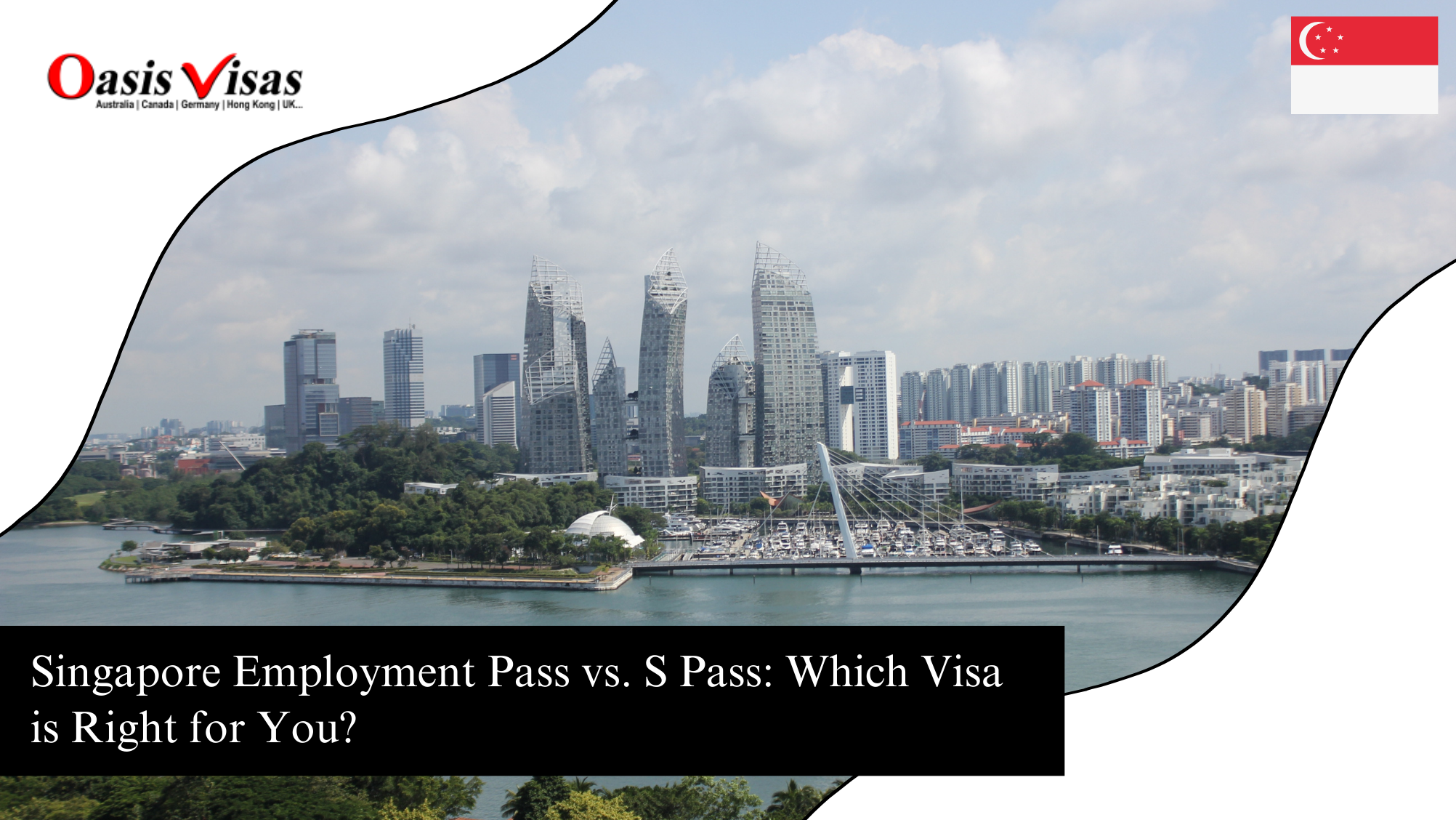
If you are planning to work in Singapore, you must understand the difference between the Singapore Employment Pass (EP) and the Singapore S Pass. Many people get confused between these two visas because both allow foreigners to work legally in Singapore.
Singapore is one of the most popular countries for professionals who want to build a strong international career. With a stable economy, high salaries, clean environment, strong passport power and excellent lifestyle, Singapore attracts thousands of foreign workers every year.
However, these passes are designed for different types of professionals, different salary levels and different job roles. Choosing the right pass is very important because it affects your salary eligibility, job opportunities, chances of bringing family members and even your future Permanent Residency (PR) plans.
In this detailed guide, we will explain everything in simple and easy language so that you can clearly understand which visa is best for you: Singapore Employment Pass or S Pass.
What is the Singapore Employment Pass (EP)?
The Employment Pass (EP) is meant for foreign professionals, managers, executives and specialists who want to work in Singapore.
This visa is suitable for:
- Degree holders
- Skilled professionals
- Managers and executives
- High-income employees
Key Features of Employment Pass
- Minimum Salary Requirement: The minimum qualifying salary is higher compared to S Pass. It usually starts from a fixed amount set by the government and increases based on your age and experience.
- No Foreign Worker Quota: Companies do not have a strict quota limit for hiring EP holders.
- No Levy (Tax on Employer): Employers do not need to pay a monthly levy for EP holders.
- Family Benefits: Singapore Employment Pass holders can apply for Dependent Pass for spouse and children (if salary meets required limit).
- Validity: Usually issued for 1 to 2 years initially and renewable.
What is Singapore S Pass?
The S Pass is meant for mid-level skilled workers.
This visa is suitable for:
- Diploma holders
- Technicians
- Supervisors
- Skilled workers
Key Features of S Pass
- Lower Salary Requirement: The minimum salary required is lower than the Employment Pass.
- Quota System: Companies have a quota limit on how many S Pass holders they can hire.
- Levy Required: Employers must pay a monthly levy for each S Pass worker.
- Family Benefits: Only allowed if salary meets higher requirements.
- Validity: Usually valid for up to 2 years and renewable.
Singapore Employment Pass vs S Pass: Major Differences
Let us clearly compare both visas in simple points.
| Feature | Employment Pass (EP) | S Pass |
| Target Group | Professionals, Managers | Mid-level Skilled Workers |
| Minimum Salary | Higher | Lower |
| Quota | No quota | Subject to quota |
| Levy | No levy | Levy required |
| Family Sponsorship | Easier | Limited |
| PR Chances | Higher | Moderate |
1. Salary Difference
One of the biggest differences between Singapore Employment Pass and S Pass is salary.
- Employment Pass requires a higher monthly salary.
- S Pass requires a lower salary.
If your job offer is high paying, you will likely qualify for EP.
If your salary is moderate, S Pass may be suitable.
2. Education Requirement
- Singapore Employment Pass usually requires a university degree.
- S Pass may accept diploma or technical qualification.
However, experience also plays a big role.
3. Quota System
For S Pass:
- Companies can hire only a limited number of S Pass workers.
- The limit depends on industry.
For EP:
- No strict quota.
This makes Singapore Employment Pass more flexible for employers.
4. Levy Cost
- EP: No monthly levy.
- S Pass: Employer pays monthly levy.
Because of this, many employers prefer EP if the candidate qualifies.
5. Bringing Family to Singapore
This is very important for married professionals.
Employment Pass holders:
- Can bring a spouse and children if earning above required salary.
- Can apply for a Dependent Pass.
S Pass holders:
- Can bring family only if earning a higher salary.
- Conditions are stricter.
If your long-term goal is to move with family, EP is better.
6. Permanent Residency (PR) Chances
Both Singapore Employment Pass and S Pass holders can apply for PR in Singapore.
However:
- EP holders generally have better PR approval chances.
- Higher salary and higher job position improve PR profile.
If your goal is Singapore PR, the Employment Pass is usually stronger.
Which Visa is Right for You?
Now the main question: which one should you choose?
Choose Employment Pass if:
- You have a university degree.
- Your salary is high.
- You are applying for a manager or executive role.
- You want better PR chances.
- You want to bring family easily.
Choose S Pass if:
- You are a mid-level skilled worker.
- Your salary is moderate.
- You have a diploma or technical qualification.
- Your employer offers an S Pass category.
Application Process: EP vs S Pass
Both passes are applied by employers in Singapore.
Step-by-Step Process:
- Employer submits application.
- The government reviews salary, qualification and job roles.
- If approved, you receive In-Principle Approval (IPA).
- Travel to Singapore.
- Complete medical test and biometric.
- Get a pass issued.
Processing time:
- Usually 3 to 8 weeks.
Common Mistakes to Avoid
- Providing incorrect documents.
- Not checking salary requirements.
- Applying for the wrong category.
- Fake degree or experience.
- Ignoring quota limits for S Pass.
Always ensure documents are genuine and complete.
Industry Differences
Certain industries prefer S Pass workers:
- Construction
- Marine
- Manufacturing
- Service sector
EP is common in:
- IT
- Finance
- Banking
- Corporate jobs
- Consulting
Can You Switch from S Pass to Employment Pass?
Yes, it is possible.
If:
- Your salary increases.
- You get a promotion.
- You meet EP criteria.
Employers can apply to upgrade your pass.
Which Pass is Better Long Term?
If you are thinking long term:
- Singapore Employment Pass gives better flexibility.
- Singapore Employment Pass gives a stronger PR profile.
- Singapore Employment Pass allows better family options.
- Singapore Employment Pass has no quota pressure.
But if you are starting your career and salary is lower, S Pass is a good entry point.
Both Singapore Employment Pass and Singapore S Pass are excellent work visa options. The right choice depends on your salary, education, job position and long-term plans.
If you are a highly skilled professional aiming for leadership roles and better Permanent Residency chances, the Employment Pass is usually the stronger option. If you are a mid-level skilled worker starting your international journey, the S Pass is a practical and smart pathway.
Before applying, always check the latest salary rules and eligibility requirements, as policies may change from time to time. Submitting the correct documents and applying under the right category is very important to avoid rejection.
Ready to Work in Singapore? Let Oasis Visas Guide You
Choosing between the Singapore Employment Pass and S Pass can feel confusing but you do not have to figure it out alone.
At Oasis Visas, our experts will:
- Check your eligibility for Employment Pass or S Pass
- Guide you on the latest salary and qualification requirements
- Help prepare strong and accurate documentation
- Reduce the risk of rejection
- Assist with long-term planning, including Singapore PR
Whether you are a professional, manager, technician or skilled worker, we provide step-by-step support throughout your visa process.
Book your consultation with Oasis Visas today..
Oasis Visas – Turning Your Global Career Dreams into Reality.