

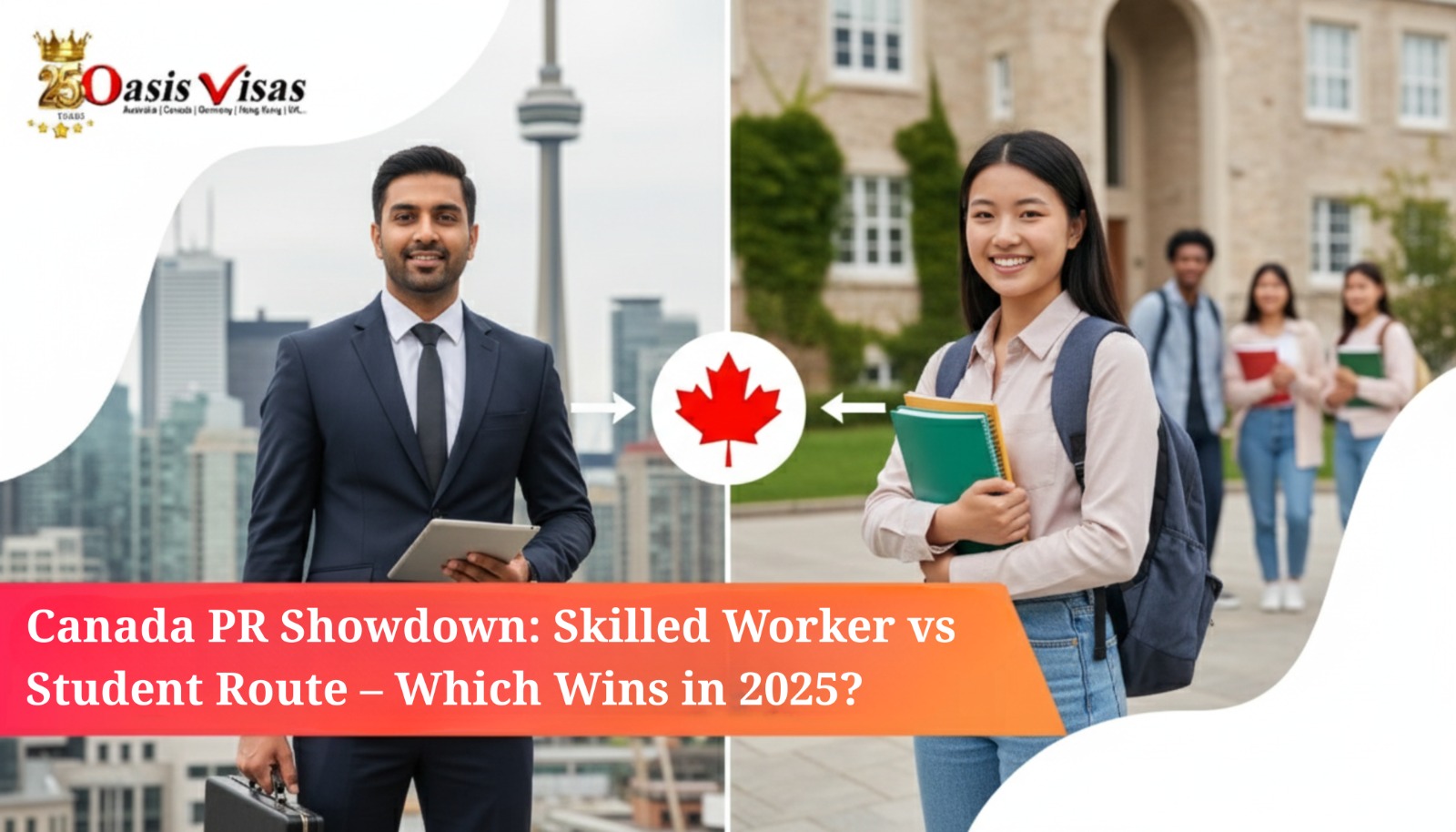
Many people who seek a Canada PR do not qualify for the same directly and hence they look for alternate pathways such as coming temporarily as a student or worker first and then applying for PR later so as to boost their chances. Canada PR is one of the most sought after residence permits in the world and the process to get it is tough and competitive. This article uses Statistics Canada’s study titled “Tracking yearly shifts in residency status amongst Canada’s work and study permit holders”. The study focuses on the residency status of work permit and study permit holders as of December 31 each year (2018-22) and tracks their status over the next one or two or three years.
By using the above official data by Statistics Canada, we will see which pathway is strategically the best to get PR based on your profile and goals. By looking into how past cohorts have transitioned, newcomers can make informed decisions about whether to come to Canada as a worker or a student based on their goal, budget and timeline.
What is Canada PR?
Canada PR gives the right to a person to live and work in Canada indefinitely. All Canada PR holders are entitled to certain rights except the right to vote in Canadian elections and hold certain government jobs in Canada. Canada PR holders are protected under the Canadian Charter of Rights and Freedoms and get various social security benefits and are given a pathway to Canadian Citizenship.
To retain their Permanent Residence, a person has to live at least two years out of five consecutive years in Canada. Apart from direct pathways to Canadian PR, the temporary routes are to get a temporary work permit or a temporary study permit and then convert it to PR in the future. The type of pathway is dependent on eligibility, financial capacity, career goals and program changes.
Why choose between these two pathways:
It is important for candidates to choose between these two pathways because:
- It helps one to know how fast a pathway leads to Canada PR as some pathways lead to Permanent Residency faster than others.
- It helps one to know the number of steps required so that a person is able to understand each step and go through the same with ease.
- The faster the pathway the more predictable the outcome. Slower pathways that take extra months or years to get to Canada PR are risky as the visa and immigration laws of Canada are changing with time. The greater the time taken the higher the risk and the greater is the chance that your timeline does not match with your goals or eligibility criteria has changed to your detriment.
Pathway 1 – Getting a student permit:
The first pathway is to get a student permit and come to Canada. For a student the journey to Canada PR is a three step process which as follows:
- Step 1: Get a student visa
- Step 2: Get a Post Graduate Work Permit (PGWP), which is part of International Mobility Program (IMP)
- Step 3: Get the Canada PR
This route is the smallest and quickest route for Canada based foreign students to convert their student permit to PR. This is because the International Mobility Program has been cited in the report to have the highest transition rate to Permanent Residency. It has been estimated that 32-38% of students switched to a new temporary residence permit within one year of holding a study permit. Almost 48%-59% switched to new temporary residence permits within two years. This is higher than what we see for the Temporary Foreign Workers Program and International Mobility Program over the same time period.
Given most study programs last 8 months to 3 years, this timing fits perfectly when students become eligible for the Post Graduate Work Program. Statistics Canada data implicitly confirms that 20% of IMP permits were Post Graduate Work Program in 2018 that rose to 28% in 2020 and 2021. Statistics Canada Dataset implicitly describes that most students follow the Study Permit to Post Graduate Work Program (IMP) to PR pathway rather than directly applying for PR.
A second pathway for students is to directly transition to PR. According to Canada Statistics website the following figures can be ascertained namely:
| Program | Cohort Year | PR in Year 1 | PR in Year 2 | PR in Year 3 |
| Student | 2018 | 1.9% | 3.7% | 19% |
| Student | 2019 | 4.6% | 9.8% | 20.1% |
The major takeaway from above information is that more students transitioned to PR status through the IMP route as compared to students directly transitioning to PR.
Note: While the dataset does not explicitly label these types of transitions, the evidence strongly suggests that most students follow the IMP pathway rather than moving directly to PR.
Pathway 2 – Getting a Canada Work Permit:
Statistics Canada has shown how quickly different groups have transitioned to PR. There are two types of workers category namely Temporary Foreign Worker Program and International Mobility Program.
Here’s a clear markdown table summarizing the Permanent Residency (PR) transition rates for both the Temporary Foreign Worker Program and the International Mobility Program cohorts of 2018 and 2020:
For Temporary Foreign Worker Program the table is as follows:
| Program | Cohort Year | PR in Year 1 | PR in Year 2 | PR in Year 3 |
| Temporary Foreign Worker Program | 2018 | 13% | 20.8% | 36.5% |
| Temporary Foreign Worker Program | 2020 | 15.7% | 29.6% | 42.2% |
For Immigration Mobility Program the table is as follows:
| Program | Cohort Year | PR in Year 1 | PR in Year 2 | PR in Year 3 |
| Immigration Mobility Program | 2018 | 15.2% | 25.9% | 46.8% |
| Immigration Mobility Program | 2020 | 34.6% | 51.9% | 63.8% |
These tables highlight that workers under the International Mobility Program (IMP) generally transitioned to permanent residency at a higher rate compared to those in the Temporary Foreign Worker Program for both cohorts. The major takeaway was that IMP workers transitioned to PR status at a higher rate as compared to workers under the Temporary Foreign Workers Program.
Which Pathway is the best?
The IMP pathway appears to be the clear winner by having the fastest and highest transition rates to PR. But there’s a caveat: The data does not separate PGWP holders from other IMP permit types, so it is not clear how many of the IMP permit holders who transitioned to PR status first started as students before moving into the IMP cohort.
The second best route is the Temporary Foreign Worker Program. But since the removal of job offer points from the Express Entry pool will likely make PR conversion harder for many TFWP workers, it would be difficult for new cohorts to transition to PR in 2025 and coming years. If not, the time to get PR through this route would increase.
The longest route with more steps, costs, and timelines is transitioning directly from Study permit to PR. Still a relevant route for those who do not initially qualify for a work permit.
Even though many people think coming to Canada through student visa might not be a viable route to gain PR, it overlooks the fact that most students transition to Post Graduate Worker Program under IMP and then move to PR. Since IMP is one of the best routes for getting a Canada PR hence the three step from study visa to IMP to Canada PR route is recommended for students. But it comes with a caveat that one should choose to study in a PGWP eligible course only and plan to work in Canada after studies are over.
As demonstrated in this article there are many ways to get a PR and the right way depends on your eligibility, financial capacity, career goals and program changes. So as to keep up to date one should ask the experts regularly. Click on the link below to know more about Canada PR and its pathways.