

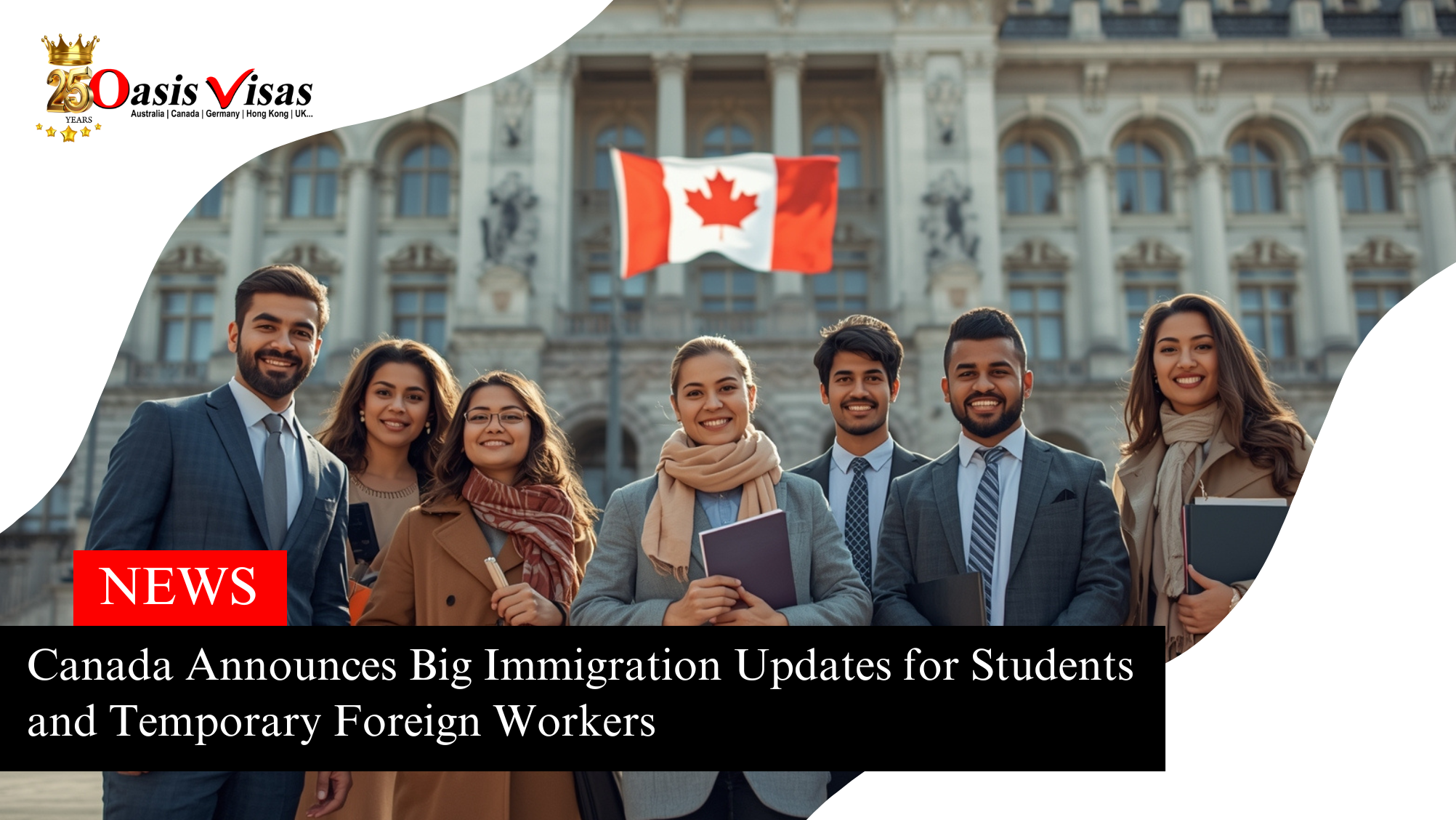
Canada is preparing to introduce a series of major immigration reforms that will have a strong impact on international students and temporary foreign workers. These updates are linked to the recently announced 2026–2028 Immigration Levels Plan and Budget 2025, which outline how the federal government intends to reshape Canada’s immigration structure in the coming years. The upcoming months are expected to bring several important policy changes.
Changes Affecting Temporary Foreign Workers in Canada
Faster pathway from temporary resident to permanent resident
According to the 2026–2028 Immigration Levels Plan, Canada intends to speed up the transition of up to 33,000 temporary workers to permanent residency in 2026 and 2027. The government has not yet shared details on how the faster pathway will be implemented, but Immigration, Refugees and Citizenship Canada (IRCC) has confirmed that the focus will be on workers who have already built strong community ties, contribute to the economy through taxes, and are employed in key labour-shortage sectors.
Canada has tried this type of pilot before in 2021, a temporary resident to permanent resident program opened and filled on the same day. Over the past year, the PR system has increasingly favoured individuals with Canadian work experience. In fact, the latest Express Entry annual report shows that 64% of candidates invited to apply for PR in 2024 had at least one year of eligible Canadian work experience.
Stricter rules expected under the Temporary Foreign Worker Program (TFWP)
In September 2025, Prime Minister Mark Carney signaled that changes were coming to the TFWP, emphasizing that the program must focus on specific sectors and regional labour needs. The details have not yet been released.
Last year, Canada paused the processing of Labour Market Impact Assessments (LMIAs) which are required for most TFWP work permits in regions with unemployment rates of 6% or higher. The new Immigration Levels Plan also reduces the number of approved TFWP arrivals for 2026 from 82,000 to 60,000, pointing toward tighter eligibility conditions for LMIA approvals.
More sector-specific PR and work permit programs on the way
Canada’s immigration strategy is shifting toward skilled workers in targeted industries. Several new programs are expected to launch soon, including:
- PR pathway for H1-B visa holders, especially those in technology, healthcare, research and advanced sectors
- PR opportunity for construction workers, reserving spaces for up to 6,000 undocumented construction workers already in Canada
- Agriculture and fish processing stream, which will come with a sector-specific work permit
Additionally, some existing immigration pilots will reopen for new applications in 2026, including the Home Care Worker Immigration pilots.
Because Canadian work experience is heavily valued in these pathways, temporary foreign workers already in Canada will be among the best-positioned applicants once these programs launch.
Changes Affecting International Students
Expected reduction in the study permit cap
Over the past two years, Canada has placed a cap on the number of study permit applications it accepts for processing. A new update is expected in January 2026, when the government will announce the cap for the year.
The new Immigration Levels Plan reduces the number of new international student arrivals in 2026 from 305,900 to 155,000, suggesting that the upcoming cap may also be significantly lower. This could make the competition for study permits more intense. However, because Canada fell short of its 2025 student targets, the impact on new applicants might not be as dramatic as expected.
Graduate students to be exempt from the study permit cap
Starting January 1, 2026, Master’s and PhD applicants will no longer be counted under the study permit cap. They will also not require a Provincial or Territorial Attestation Letter (PAL/TAL). In addition, IRCC will fast-track applications for PhD students and their immediate family members, allowing approval in as little as two weeks.
Program removals from PGWP eligibility
In June 2025, IRCC updated the list of study programs eligible for the Post-Graduation Work Permit (PGWP), potentially affecting students planning to secure Canadian work experience after completing their studies. Although the removal of certain programs was postponed in July, IRCC confirmed that the changes will take effect in early 2026.
Until then, 178 programs that were expected to lose PGWP eligibility will continue to qualify. Students intending to work in Canada after graduation should make sure they select a PGWP-eligible program.